

Recently, the 2025 Wet Electronic Chemicals Industry Development Report (hereinafter referred to as the Report) released by Shenzhen Enterprise Investment Industry Research Institute has attracted wide attention in the industry. The value of this Report lies not only in its systematic summary of the global wet electronic chemicals industry chain, but also in its review of the competitive landscape of core enterprises worldwide, providing market value references. As a provider specializing in ultra-clean chemical transmission and packaging solutions, Baoshili has profoundly interpreted the new standards and strategic opportunities put forward by the industry's march toward high-end development for the upstream supply chain from this authoritative Report.
Market Growth at a High Speed, Integrated Circuits as the Core Engine
The domestic market demand shows a strong momentum. The total demand in 2024 reached 4.5097 million tons, a year-on-year growth of 22.3%. Among them, the demand in the integrated circuit sector, which has the highest technical threshold, hit 1.2535 million tons, surging by 30.23% year-on-year. Leading the growth rate, it has become the core driving force of market growth. It is estimated that the demand will further climb to 1.8401 million tons by 2028, with market increments and value rapidly concentrating in the most cutting-edge application fields.
Remarkable Progress in Localization, Characterized by "Layered Breakthroughs"
Domestic substitution has achieved remarkable results, yet the structure remains uneven. The localization rate of wet electronic chemicals in the photovoltaic sector has reached nearly 100%, and that in the display panel sector has exceeded 54%. In the semiconductor sector, the progress of some general-purpose wet electronic chemicals (such as G5-grade sulfuric acid and hydrofluoric acid) is rapid, with the comprehensive domestic market share reaching 55%. However, in the field of high-value-added and technologically complex functional wet electronic chemicals (such as high-end CMP polishing slurries, high-selectivity etching solutions, and advanced packaging electroplating solutions), domestic capabilities are still relatively weak, and the high-end market mainly relies on imports. The localization of wet electronic chemicals has entered a critical stage of tackling key problems in "in-depth substitution" from "extensive substitution".
Significant Gradient Distribution between Technical Threshold and Profit Margin
The Report concludes that the photovoltaic industry mainly uses G2-G3 grade products, the display panel industry requires G3-G4 grade products, while advanced integrated circuit processes (below 28nm) must meet G4-G5 grade standards, with a high proportion of functional chemicals, thus achieving the highest gross profit margin. This positioning is crucial for enterprises in the industry chain to clarify their own technological upgrading paths and market strategies.
Currently, advanced semiconductor processes are driving the standards of wet electronic chemicals toward SEMI G5 Grade (metal impurities ≤ 10ppt, i.e., parts per trillion) and even higher levels. This trend has generated a vital derivative demand for the industry: the scope of quality control has been strictly extended from a single production link to the entire supply chain including packaging, storage, and transportation.
Under the purity requirement of ppt level, the interface where chemicals come into contact with packaging and transmission systems has become a potential pollution risk area that cannot be ignored. Trace ion precipitation, organic matter dissolution, and surface particle shedding from packaging materials themselves, or residues and permeation in transmission pipelines, may cause fatal pollution to ultra-high-purity chemicals, directly endangering their performance and leading to yield loss in downstream chip manufacturing. Therefore, the purity management of the industry chain has become a systematic project covering "chemicals themselves - packaging materials - transmission systems".
In response to the trend of industrial high-end development, Baoshili focuses on solving the purity problem of ultra-high-purity materials, and creates ultra-high-purity transmission and packaging products for wet electronic chemicals through source material control and precision processing technology.
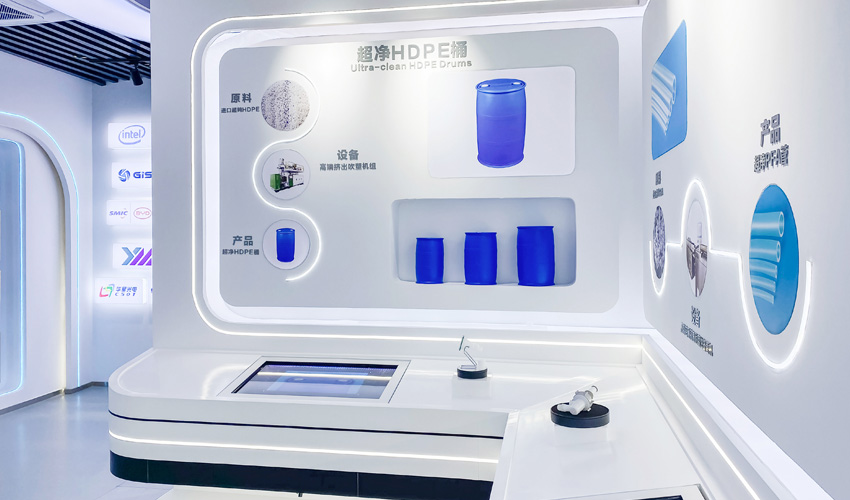
To meet the ppt-level impurity control requirements of advanced manufacturing processes, Baoshili's product series undergo strict raw material screening at the source. Specialized modifications are made to extrusion, injection molding and other processing equipment, and the technological process is optimized to minimize the introduction of metal ions, particles and organic pollutants by the products themselves, ensuring that they serve as safe containers for wet electronic chemicals.
In the field of high-end ultra-clean packaging and transmission components, the domestic market has long relied on imports. Baoshili is committed to breaking through this "invisible barrier" and realizing the localization substitution of key ultra-clean components through independent technology. This not only helps domestic wet electronic chemicals enterprises reduce supply chain costs and risks, but also serves as an indispensable part of building a complete, safe and independently controllable high-end electronic materials industry chain.
 online service
 +86 592 625 8655-ext-622
 carrie@xmbsl.com
 carrielin36
 +8613850062482


 English
 français
 español
 日本語
日本語 Tiếng việt
 中文
中文